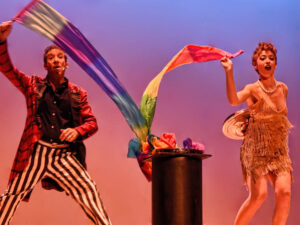

Humans love magic. Discord servers, YouTube channels, and Instawitches show that magic is more popular than ever. We enjoy performances where skilled magicians make lemons or elephants appear and disappear before our eyes. Not many academic philosophers discuss magic, however, five centuries ago, prominent Renaissance philosophers, such as Marsilio Ficino (1433–1499), Giovanni Pico della Mirandola (1463–1494), and Giordano Bruno (1548–1600), wrote extensive treatises on the topic. They conceived of magic as the ability to work wonders, and as such it merited close philosophical attention.
In Wonderstruck, I treat magic (like science and religion) as a cognitive technology that harnesses our sense of wonder. Magic connects to wonder in two ways. First, it is the ability to do wondrous things, and hence a kind of power. The word “magic” derives ultimately from the Proto-Indo European word for “power.” Second, magic is passive: it denotes our amazement at wonders we don’t fully understand. The word thaumaturgy ultimately derives from the Greek root thaumazein, which means to wonder. Magic relies on both these aspects: active power and passive wonder.
Consider a magic trick such as the cups and balls, which is cross-culturally widespread and was already mentioned in a letter by Seneca. A ball seemingly vanishes from the magician’s closed fist to reappear under a cup. This is repeated until eventually, the magician makes a lemon or some other object appear (in lieu of a ball) under one of the cups. This trick relies on object permanence, our ability to track occluded objects. The magician uses misdirection (demonstrating the cup is empty) to maneuver the ball under it. We are also beguiled because we attribute intentionality to hand gestures. The sleight of hand used is the French drop, where an object is seemingly transferred while remaining in its original position. At a neural level, there is a clear difference between surprise and wonder: a surprise action, such as a hand swiping a coin away, elicits a different response from a magical action, where a coin disappears into thin air. Adam Smith already theorized about this difference between surprise and wonder in his History of Astronomy (1795): we expect the ball to disappear and reappear in the cups and balls magic trick; we are not surprised, but we “will still wonder, though forewarned of what we are to see.”
While it is tempting to focus on sleight of hand as the essential part of stage magic, magical performances are a more encompassing art that strive to create beauty and a compelling narrative. As stage magician and philosopher Larry Hass explains, witnessing magic can be empowering because as the audience you get to share in the idea that we can achieve the impossible. Stage magician Teller describes magic as a kind of playful epistemology, “the heaviest philosophical ideas you can possibly have, dealt with in the silliest way.”